
How often to use red light therapy for hair growth
-
The Science: How Red Light Actually Wakes Up Follicles
-
How Many Times a Week Should You Use Red Light Therapy for Hair Growth?
-
If you want the short answer based on the majority of successful clinical trials: 3 to 4 times per week.
- Daily vs. Every Other Day: What the Studies Actually Say
- The "Sweet Spot" Duration: Why 10-20 Minutes is Enough
-
Can You Overuse Red Light Therapy for Hair Growth?
-
The Timeline: How Long Before You Actually See Results?
- The "Shedding Phase": Why Losing Hair at First Can Be a Good Sign
- 3 to 6 Months: Identifying the Early Signs of Regrowth
-
-
Maximizing Absorption: Optimization Tips for Better Results
- Clean Scalp vs. Product Buildup: Does It Block the Light?
-
Combining Therapies: Stacking RLT with Other Hair Growth Protocols
- Red Light + Microneedling?
-
Real-Life Expectations: Does It Really Work?
-
The Number One Mistake That Ruins Results
-
Conclusion: Is It Worth the Time Commitment?
- Frequently Asked Questions (FAQ)
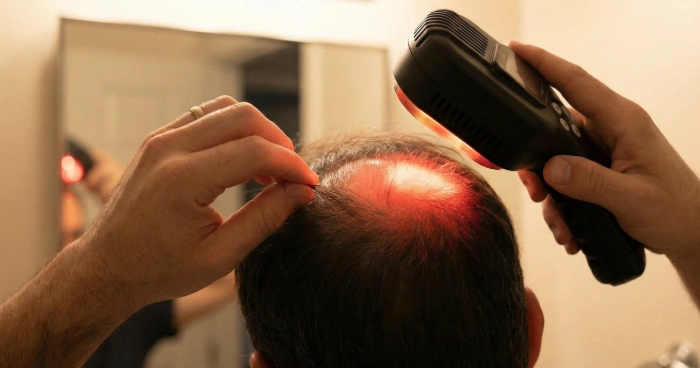
There is a certain way you might panic when you first notice the thinning. It usually happens when you catch a glimpse of your scalp in a bathroom mirror. Or... maybe you notice it in a group photo sent to you. Suddenly, that expensive red light helmet you’ve heard about doesn't feel like a “just in case” gadget anymore. It feels like it might be a lifeline.
For those of you that already have a red light therapy device for your hair, you might often open the box, stare at the blinking lights, and the questions start to come up. The manuals are usually vague, offering a generic "use as directed" guidance… while you are left wondering what that actually means for your head and results.
Your first instinct is probably to blast your scalp for an hour every single day. If a little light is good, a lot of light must be better, right? You want to wake those follicles up immediately.
That instinct is wrong!
Treating this technology like a sheer volume game is the fastest way to ensure it doesn't work. I am not a doctor, and I don't pretend to be one. I am just someone who is obsessed with figuring out which tools actually deliver on their promises and which ones are just expensive paperweights. I have spent weeks digging through the clinical data to find the specific protocol that balances stimulation with recovery.
Here is the unfiltered truth on how often to use red light therapy for hair growth to actually see results.
The Science: How Red Light Actually Wakes Up Follicles
Before we talk about real schedules, we have to strip away the marketing fluff and understand what is happening under that helmet (or cap). It isn't magic, and it isn't just "warming up" your skin. It is a biological mechanism called Photobiomodulation (PBM).
When you shine specific wavelengths of light (usually around 650 - 850nm) onto your scalp, those photons penetrate past the skin and hit the base of the hair follicle,.. known as the papilla. Inside the cells of that papilla are tiny “engines” called mitochondria.
Think of a dormant or thinning hair follicle like a car engine that is literally sputtering for its dear life because it is out of gas. It is barely keeping the hair shaft alive. This is why the hair grows thinner (and wispier). The red light acts like a fuel injection. It stimulates an enzyme called cytochrome c oxidase. This enzyme kicks off a chain reaction that dramatically increases the production of Adenosine Triphosphate (ATP).
ATP is cellular energy. When your follicle cells have a surplus of energy, they can now afford to switch from "survival" to "growth." All this isn't just a theory. A mechanistic study on Hair Growth Promoting Effects of 650 nm Red Light Stimulation on Human Hair Follicles confirmed this at a genetic level. The researchers found that the light activated specific pathways that actually delayed the "catagen" phase (the phase when the hair stops growing and is about to prepare to fall out). Basically, the light convinces your hair to keep growing for longer.
How Many Times a Week Should You Use Red Light Therapy for Hair Growth?
If you want the short answer based on the majority of successful clinical trials: 3 to 4 times per week.
Most manufacturer guidelines and successful studies converge on this specific frequency. It also mimics the kind of cadence you might have heard in strength training. You need the stimulation to trigger the response, but you also need the recovery time.. for the cellular changes to take hold.
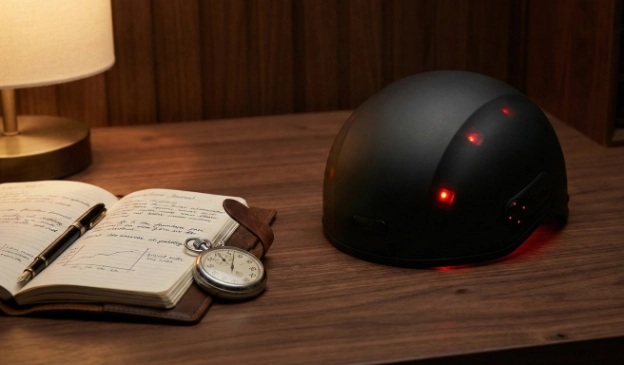
Treating hair loss requires a protocol, not just a gadget. Tracking your sessions is the best way to avoid the "more is better" trap.
Daily vs. Every Other Day: What the Studies Actually Say
There is a massive debate in the optimization community about daily use. While it is tempting to make this a daily ritual, the data suggests that consistency beats intensity. The "Rest Day" theory you've heard before, is critical here. Just like your muscles need time to repair and grow after a heavy workout, your hair follicles likely need a "rest period".
Real world logs from people who have been doing this for years also show a clear pattern. Those who stick to an every other day schedule tend to have better long term adherence. It is just mentally easier to commit to three sessions a week than to feel guilty every time you miss a daily session. Simple as that. If you are the type of person who thinks pushing harder is the only way to win, you might be wondering can you do red light therapy twice a day?. The answer is almost universally no for this application. You aren't speeding up the process; you are just exhausting the cellular machinery.
The "Sweet Spot" Duration: Why 10-20 Minutes is Enough
You do not need to sit under a lamp for an hour. In fact, doing that might actually hurt your progress. The exact time depends entirely on the power output, or irradiance, of your device.
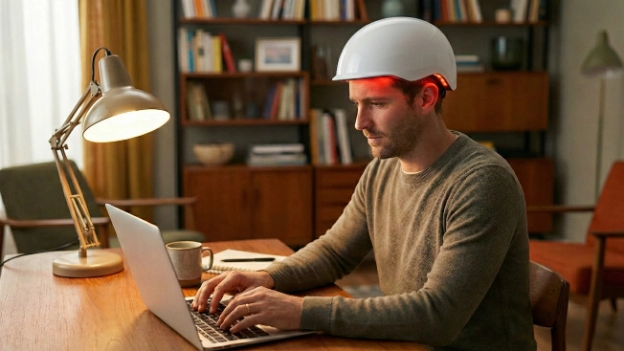
Efficiency in action: Using a wearable cap allows you to hit your 3-4x weekly frequency without disrupting your workflow.
If you invested in a premium laser cap / hat that puts out high energy (over 80 mW/cm²), you might only need 6 to 12 minutes to get the effective dose. These devices are powerful, and more time doesn't equal more growth.
For the standard home caps that most people own, 10 to 20 minutes is the standard recommendation because they sit in the mid power range zone. This helps deliver enough total energy to hit the target without overheating the scalp.
If you are trying to use a generic LED panel that you bought for your skin, you might actually need 20 to 30 minutes to get the same effect on your scalp because the light is further away (and less concentrated).
Can You Overuse Red Light Therapy for Hair Growth?
Yes, you absolutely can. This is the most common mistake people make. Its almost heartbreaking to see someone so dedicated.. that they sabotage their own results because they are trying too hard.
In science, this is called the “Biphasic Dose Response”. It basically means there is a "Goldilocks Zone" for light therapy. If you deliver too little energy, the cells don't wake up. If you deliver the right amount, you get that surge of ATP and growth. But if you deliver too much, the benefits slow down. You can actually inhibit the very growth processes you are trying to start.
Your goal is to hit an energy delivery of roughly 5 Joules per square centimeter. Once you go significantly past that, you hit the point of diminishing returns. Think of it like watering a plant. The right amount of water makes it grow. Flooding it with a hose for three hours doesn't make it grow faster… it just drowns the roots.
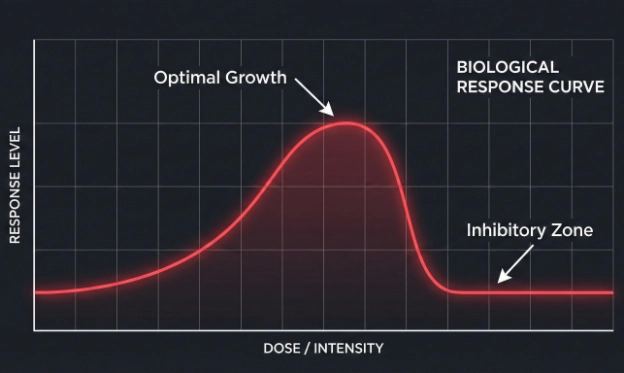
The "Goldilocks Zone" of light therapy. Staying within the optimal window stimulates growth, while pushing too far into the "Inhibitory Zone" can actually stall your progress.
To truly understand these biological limits and why moderation is key, it helps to look at the core red light therapy benefits for hair. The benefit comes from the stimulation, not the over saturation.
The Timeline: How Long Before You Actually See Results?
Managing your expectations is the hardest part of this entire journey. We live in a world of instant gratification, but biology is slow.
The "Shedding Phase": Why Losing Hair at First Can Be a Good Sign
This is the moment where most people quit. You buy the device, you use it religiously for four weeks,.. and then you look in the shower drain and see more hair than usual. You panic. You assume the device is destroying your hair,.. so you shove it in a closet (or return it) and sweat to never touch one again.
Please, don't do that.
That shedding is actually a sign the therapy is working. The light is pushing your dormant follicles into the Anagen (growth) phase. As the new, strong hair starts to form deep in the scalp, it has to push out the old and weak "club hair" that was sitting there (and waiting to fall out anyway). To nicely put it, that initial shed is just the old guard making way for the new recruits. It is a temporary, necessary evil.
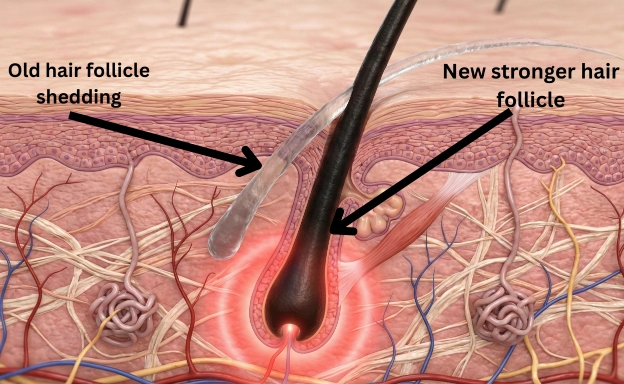
Strong new Anagen hairs (bottom) must physically push out the weak Telogen hairs (top) before they can break the surface.
3 to 6 Months: Identifying the Early Signs of Regrowth
You likely won't see anything visible in months one through three. You might notice your scalp feels healthier or less oily,.. but the mirror won't show much change.
Months three to six are when the new hairs finally break the surface and start to add density. Clinical trials, like the one studying The efficacy and safety of the combination of photobiomodulation therapy and pulsed electromagnetic field therapy on androgenetic alopecia, have shown measurable density increases in this timeframe. In that specific study, the treatment group saw a 17% increase in hair density compared to the control group. That is the difference between seeing your scalp and seeing real coverage.
Maximizing Absorption: Optimization Tips for Better Results
If you are going to spend 20 minutes sitting with a glowing helmet on your head, you might as well make sure every photon counts.
Clean Scalp vs. Product Buildup: Does It Block the Light?
Yes, it does. Light photons are fragile. If you have a layer of hair fibers, dry shampoo.. Or layers of thick styling gel on your scalp,.. the light might never reach the follicle.
The best practice is to use your device on a clean, dry scalp. Ideally, do it after a shower (after your hair is dry). Do not apply heavy oils like castor oil before the session thinking it will "cook" into the scalp. Just save them for after the session is done.
Many people try to multitask with large panels. They try treating their face and hair at the same time. If you are curious about the skin benefits, you should read up on how to use red light therapy on your face.. to ensure you aren't getting too close.
Combining Therapies: Stacking RLT with Other Hair Growth Protocols
If you are the type of person who tracks your sleep scores and optimizes your nutrient intake, you probably shouldn't rely on red light therapy alone. Why?! Because It works best as a force multiplier.
For men specifically, hair loss can be deeply tied to hormonal factors. Understanding the link between red light therapy testosterone and overall physiology can give you a broader picture of how light affects your entire system.
Red Light + Microneedling?
This is the power combo that a lot of people follow. Microneedling involves using a roller (or stamp) with tiny needles to create micro channels in the scalp. This triggers a wound repair response. When you add Red Light Therapy on top of that, you are giving the cells the extra energy they need to execute that repair job.
Many successful people dermaroll once a week and use red light on the other days. If you really want to optimize, looking into the differences between pemf vs red light therapy reveals how magnetic fields can provide a further boost in circulation… potentially offering another layer of synergy.
Real-Life Expectations: Does It Really Work?
I’m not here to sell you a dream. I’m here to tell you what actually happens. The data supports the technology, but it isn't a miracle for everyone.
A comparative study on the Efficacy of Low-Level Laser Therapy in Androgenetic Alopecia: A Comparative Study with Minoxidil pitted light therapy directly against the standard topical treatment. The result was fascinating. The light therapy group saw a density increase of 34.5 hairs per square centimeter, while the Minoxidil group saw 24.21.
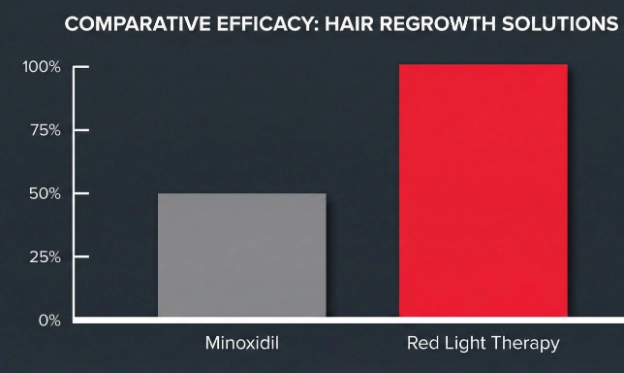
Red Light Therapy achieved a 34.5 hairs/cm² density increase, outperforming Minoxidil in the specific trial group.
This proves that for the right person, light therapy can be just as effective (if not more so), than the standard chemical options we’re used to seeing. However, there are limitations. Red light therapy cannot “raise the dead”. If you have a completely bald area that has been slick for years, those follicles are likely long gone. It works best on thinning areas where the hair that is fighting to survive. It’s not for areas where the battle was lost a decade ago.
The Number One Mistake That Ruins Results
Let’s put science to the side for a moment and be honest with ourselves. You can buy the most expensive device on the planet, but it will not work if you make one specific mistake. That mistake is inconsistency born from impatience.
The cycle usually looks like this: You use it daily for two weeks. You see slight shedding. You get scared (or bored) because you don't see a lion’s mane of hair appearing. You skip a session. Then you skip two. Go on vacation… skip a few more.. Now suddenly, the device.. is gathering dust.
Don't be that person.
You have to trust the shedding. It can be the gateway to growth. The people who see results are the ones who just keep putting the helmet on, three times a week… boringly and reliably. They do all that for six months. They don't look for changes every day. They just trust the process.
Conclusion: Is It Worth the Time Commitment?
Red light therapy is not the end all be all for baldness. It won't give you back your teenage years hairline overnight. It won't fix poor nutrition. It won't fix massive hormonal imbalances…But it is one of the most powerful tools we currently have for managing the cellular health of our scalp.
If you are dealing with the frustration of thinning hair and want a way to boost energy production at the source without relying solely on pills and prescriptions, it is worth the investment.
The key though, is to respect biology. No need to blast your scalp every day. Every other day is usually better. Stick with it for at least six months. Take control of your recovery rather than waiting for it to happen.
Frequently Asked Questions (FAQ)
1. Can I use red light therapy every day for faster results? Generally, no. Most studies and experts suggest that an every other day schedule (3 to 4 times a week) is optimal. Your follicles need a rest period to process the light energy, and daily use can sometimes lead to diminishing returns or inhibition.
2. Will red light therapy burn my scalp? It shouldn't. If you use a high quality LED or Laser device, it generates very little heat. If you feel burning, your device might be too close, or it might be an unsafe model that is emitting too much thermal heat.
3. Can I use RLT if I have had a hair transplant? Yes, many surgeons actually recommend it after the procedure to help the new grafts heal and survive. However, always consult your surgeon for the specific timeline of when to start, which is usually a few weeks post op.
4. Do I need to shave my head for it to work?
No, but the light needs to reach the scalp. If you have thick hair but are thinning at the root, try to part your hair or use a device with teeth to separate the hair and expose the skin.
5. Does it work for eyebrows or beards?
Yes, the biological mechanism of stimulating mitochondria in the follicle is the same regardless of where the hair is. Just be very careful with your eyes if treating eyebrows and always use protective eyewear.
6. What happens if I stop using it?
Like exercise, the benefits are not permanent. If you stop completely, your hair follicles will likely slowly return to their previous state over time. Most people shift to a maintenance mode of once or twice a week after they get results.
7. Can I wear a hat or styling product during the session?
No. The light cannot penetrate through fabric, and thick styling products like gels or sprays can reflect the light. Always use it on a clean, dry, bare head.
Keep Exploring
If you are serious about optimizing your recovery and wellness, check out our other deep dives:
You are already waking up blood flow in your scalp... but what about the rest of your system? We tested the famous "air squeeze" of these boots to see if they truly flush out metabolic waste, or if they are just an expensive leg massage.
You’ve mastered the cool light... now are you ready for the deep heat? We wrapped ourselves up like a human burrito to find out if you can actually mimic a luxury detox session while lying on your living room floor.
The study we mentioned proved that stacking magnetic fields with red light supercharged hair growth. But what actually is this invisible pulse? We dug into the tech that claims to be a "wireless battery charger" for your cells.
This article is for informational purposes only and is not intended to provide medical advice. Always consult your qualified healthcare professional before beginning any new health, wellness or recovery regimen.
-
The Science: How Red Light Actually Wakes Up Follicles
-
How Many Times a Week Should You Use Red Light Therapy for Hair Growth?
-
If you want the short answer based on the majority of successful clinical trials: 3 to 4 times per week.
- Daily vs. Every Other Day: What the Studies Actually Say
- The "Sweet Spot" Duration: Why 10-20 Minutes is Enough
-
Can You Overuse Red Light Therapy for Hair Growth?
-
The Timeline: How Long Before You Actually See Results?
- The "Shedding Phase": Why Losing Hair at First Can Be a Good Sign
- 3 to 6 Months: Identifying the Early Signs of Regrowth
-
-
Maximizing Absorption: Optimization Tips for Better Results
- Clean Scalp vs. Product Buildup: Does It Block the Light?
-
Combining Therapies: Stacking RLT with Other Hair Growth Protocols
- Red Light + Microneedling?
-
Real-Life Expectations: Does It Really Work?
-
The Number One Mistake That Ruins Results
-
Conclusion: Is It Worth the Time Commitment?
- Frequently Asked Questions (FAQ)