
Red Light Therapy Mat/Blanket vs Panel: Comfort vs Power
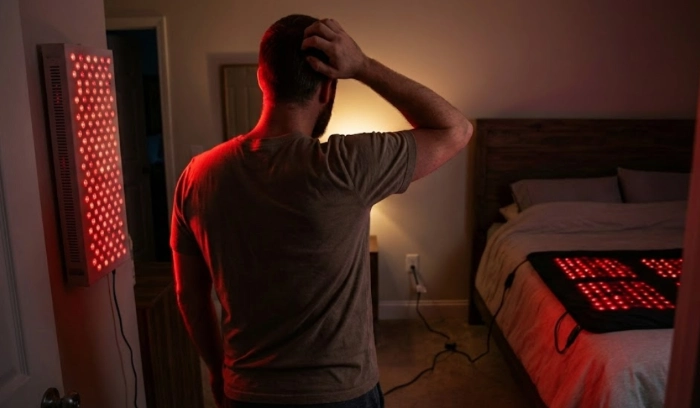
A Red light therapy blanket (or mat) vs panel is one of those choices that sounds simple until you picture your real life inside the decision. The version of you who shops for wellness tools imagines totally calm routines and glowing skin. The version of you who actually lives your week is staring at a bright panel thinking, Ok i think I'm tired of standing here for 20 mins all the time.
This is not just a “which one is better” debate. It is also a “which one fits the way you already behave”. That is because the most powerful device in the world does nothing if it eventually becomes another expensive device you promised yourself, you’d stick with, but life “got in the way”.
Red Light Therapy Blanket vs Panel: What’s the Real Difference?
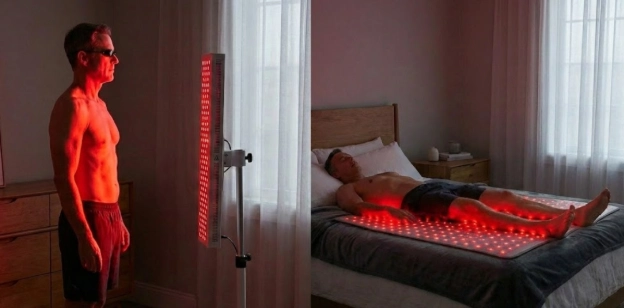
Same goal, totally different vibe: stand and aim, or lie down and melt.
A panel is basically a high powered wall of red light. You stand (or sit) at a set distance. Usually somewhere around 6 to 12 inches, and let the LEDs hit a targeted area with a lot of intensity. It is efficient. It is also a little demanding for beginners to stick with. You have to position yourself, can often treat only one side at a time… and the light is bright enough that most people end up wearing eye protection. Great results can come from panels, but they tend to ask you to pause life and do the session.
A blanket or mat is the opposite energy. You lie down. You wrap up. You breathe more. The light is gentler, the setup is basically plug it in and get comfortable. Full body exposure happens without the constant repositioning.
Here is the clean tradeoff.
Panels usually deliver higher irradiance, usually around 100 to 200 mW per cm² at an effective distance. Blankets and mats tend to land more in the 25 to 70 mW per cm² range at skin contact. That sounds like a huge win for panels… and on paper it is. Higher intensity usually means you can get a similar dose in less time.
But dose is the real story, not intensity alone.
Think of it like training. A hard ten minute workout can equal a longer moderate session if the effort adds up. With red light therapy, intensity times time is what gets you into the neighborhood of a useful dose. A 10 to 15 minute panel session can be comparable to a 20 to 30 minute mat session when you actually do the math.
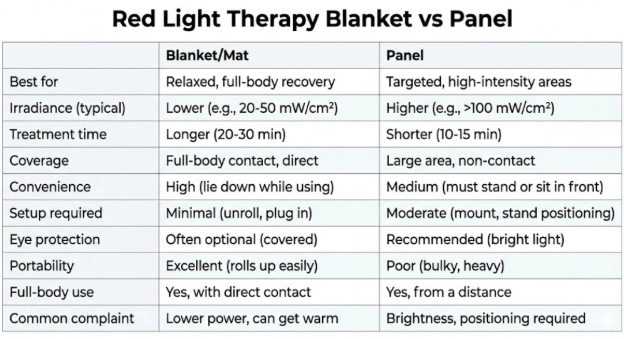
A quick snapshot of what actually changes your day to day experience.
And then the human behavior part comes in.
Most people do not quit because the science is “confusing”. They quit because the routine is annoying. Bright light, goggles, standing still, flipping around, finding a spot in the house where you can be half naked in peace. That is the hidden cost. If your life already has a lot of friction, the panel can become a “do it later” tool. The mat becomes a “do it now” tool.
This is the same reason heat based recovery tools can be a love hate relationship. Some people swear by the ritual. Others hate the hassle. We unpacked a lot of that comfort versus consistency tension in Do Sauna Blankets Work,.. and the pattern is similar here. The best tool is the one that fits your evenings without a drawn out mental negotiation.
If you are leaning blanket or mat, it also helps to be realistic about what you are buying it for. The vibe is cozy, but the goal still matters. A lot of the nuance lives in the details around Red Light Blanket Benefits, especially when people want full body support without making it a whole production every session.
Are Red Light mats as good as panels?
Sometimes yes. Sometimes no. And the reason is not a moral failing of either device. It is physics… plus lifestyle.
If you have a stubborn knee that flares up, or a shoulder that feels like it is held together by a single strand, then a panel is hard to beat for targeted intensity. You can aim it, dose it, and get in and out quickly.
If you are dealing with the kind of full body stiffness that makes you contemplate getting out of bed in the morning… or you want a calming nightly ritual that you can do even when your motivation is zero, the mat can end up being the better choice because it actually gets used.
A great high level science summary is this umbrella review: Effects of photobiomodulation on multiple health outcomes: an umbrella review of randomized clinical trials. It pulls together a huge amount of randomized trial evidence across different outcomes. When you zoom out like that, you start to see a theme: photobiomodulation has a real signal for pain, function, fatigue, and even areas like hair density and cognition. That does not mean every device works the same. It does mean the mechanism is no longer a fantasy.
So the honest answer is this: mats can be “as good” when your goal is steady, repeatable dosing across a lot of surface area… and when the lower friction makes you consistent. Panels tend to win when you need intensity, efficiency, and precision.
If you want one sentence to remember: Panels usually win the session, Mats usually win the month.
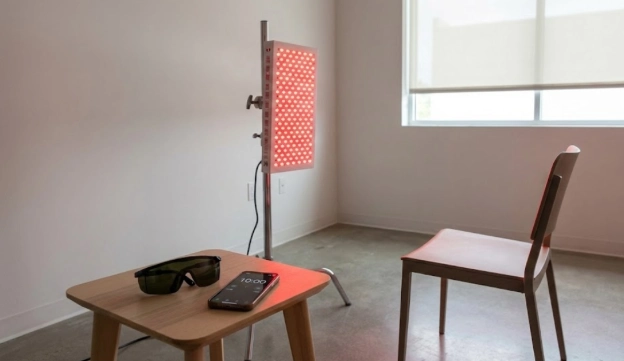
Panels can be fast and effective, but they sometimes ask you to show up like it is an appointment.
Which type of red light therapy is best?
“Best” is personal, which is likely not what you want to hear, but it is also freeing.
If your main goal is faster recovery after hard training, you can make a strong case for a panel because it is powerful and targeted. The catch is that you have to be the kind of person who will actually stand there and do it three to five times per week. If you are the kind of person (or willing to be) who tracks metrics, loves structured routines, and is willing to do the boring part to get the payoff, a panel fits that mindset.
If your main goal is sleep and stress, the mat starts looking very appealing. It pairs well with a wind down routine because it feels less like mandatory treatment and more like permission to relax. There is also actual controlled research pointing in this direction. This controlled trial is worth referring to: A randomized, sham-controlled trial of a novel near-infrared phototherapy device on sleep and daytime function. The takeaways are not “this knocks you out like a sedative.” It is more subtle. Relaxation improves. Your mood improves. The nervous system seems to respond even when objective sleep metrics do not dramatically change. That is exactly the kind of benefit people describe when a mat becomes part of their night.
If your goal is better skin, it will depend on how you like to treat your face. Panels are versatile for the face, neck, and chest (ff you can handle the brightness and you can be consistent). Mats are more full body and more passive. If your skin goals are paired with “I need this to feel easy,” the mat wins on adherence.
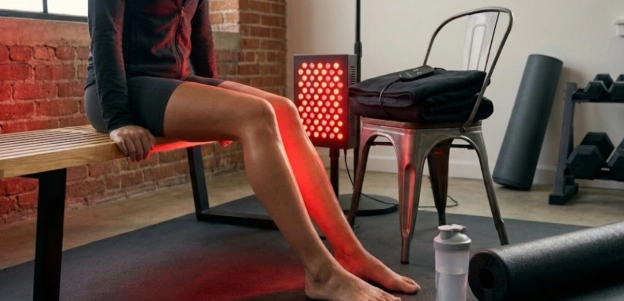
When one spot is screaming after training, targeted light makes a lot of sense
And then there is the edge of the frontier stuff. Transcranial photobiomodulation is being studied for brain resilience and inflammation. Here is a fascinating window into where the research is going: medical-grade near-infrared light therapy specific frequencies shows promise. It is not an argument that everyone needs a brain device. It is a subtle credibility signal that this field is being taken seriously enough to justify real institutional investment.
No matter which device you choose, the part that decides your outcome is the routine.
Start small. Give your body two weeks to show you how it reacts. Then go from there.
A simple approach that works for most people looks like this:
-Use it three to five times per week.
-Keep sessions comfortable, not intense.
-Treat / use bare skin
-With a panel, stay in the effective distance range recommended by the manufacturer and keep it consistent.
-With a mat, prioritize contact and enough time.
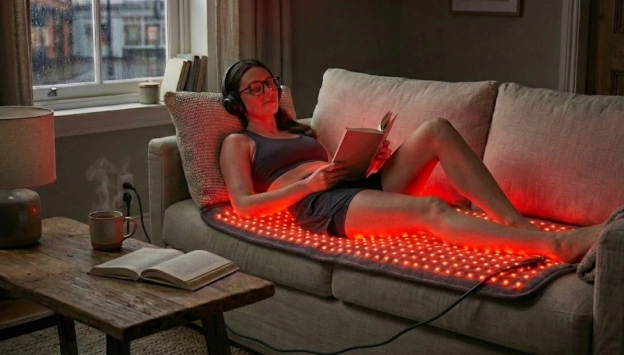
This is why mats and blankets can win the consistency battle. You can actually relax.
If you are tempted to stack sessions, the nuance matters. It is easy to turn a good thing into an overstimulating thing, and that is where Can you do Red light Therapy twice a day becomes relevant. More is not always better.
And if you are the kind of person who gets discouraged because progress feels slow, it helps to remember that most recovery tools are compounding tools. The same patience applies to heat based routines too, which is why the timelines in How long until you see the benefits of infrared saunas feel surprisingly familiar.
What is the difference between a red light panel and a lamp?
A lamp sounds like the cheaper, simpler version of a panel. Sometimes it is. Most times it is not.
The difference is coverage and repeatability.
A panel is a grid of LEDs designed to deliver a fairly consistent spread over a larger area. You can treat your face, your chest, your thighs, or your back. All with fewer repositioning steps.
A lamp is usually a single source. It can be strong for a small target, but the second you want to cover a bigger zone, you have to move it around again and again. Two minutes here becomes twenty minutes of little segments. That is fine if you are treating one small spot. It is not great if you bought red light therapy because you wanted something you could do without thinking.
So if you are truly focused on one stubborn area and you want the smallest footprint, a lamp can be a practical entry. If you know you want full body or multi area use, panels and mats are simply more realistic.
Is a Red Light Therapy panel worth it?
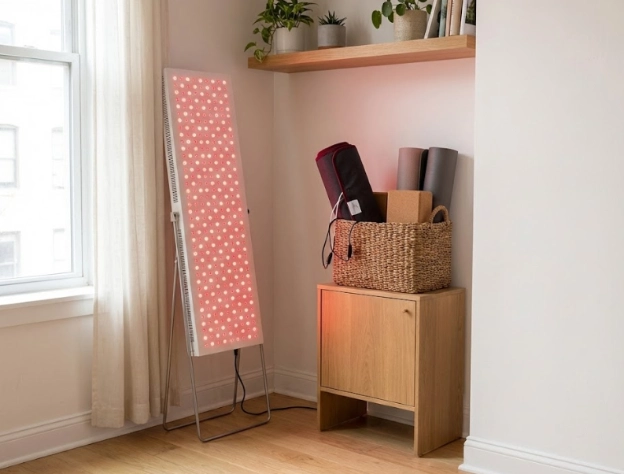
If it lives out and stays plug and play, it gets used. If it gets stored, it gets forgotten.
A panel is worth it when it becomes part of your weekly routine, not a seasonal hobby.
On paper, a quality panel can pay for itself quickly (especially if you were otherwise paying for in person sessions). In real life, the bigger question is whether you will keep it plugged in and accessible.
Here are the patterns I see over and over:
-Panels are worth it for people who love efficient sessions and do not mind being still.
-Panels are worth it when you have a dedicated corner where the device stays ready.
-Panels are worth it when you have a specific target you are trying to improve and you want intensity.
-Panels feel ‘less’ worth it when every session requires you to drag it out, find the stand, close the door, put on goggles, and stand there. That is not a character flaw. That is reality.
If you already lean toward tools that stack well with other recovery habits, it can also help to compare other tools that might deserve space in your routine. A lot of people end up deciding between modalities rather than devices, and that is where Pemf vs Red light therapy becomes a useful lens. Different tools. Different sensations. Different reasons you stick with them.
What is the downside of red light therapy?
The downside is usually not danger. It is misuse, unrealistic expectations, and occasionally some discomfort.
Most common annoyances are not a deal breaker. Your skin can feel warm or a little red afterward. Some people get dry skin if they overdo it. Bright panels can strain your eyes if you skip protection. A very small number of people feel headachey, wired, or strangely fatigued when they start. That is often a sign the dose was a bit too aggressive too soon.
There are also real guardrails.
If you have a photosensitive condition, if you take medications that increase light sensitivity, or if you have a history of seizures and you are not sure about device flicker, that is a conversation for a qualified professional.
The most common reason red light therapy “does not work” is not mysterious. It is one of these:
-The sessions are too short to matter.
-The panel is too far away to deliver a useful dose.
-Clothing blocks a lot of the light.
-The routine is inconsistent.
-The device is low quality and the output is not therapeutic.
The other reason is emotional. People expect a miracle. What red light therapy tends to do best, is make recovery feel a bit smoother. Sleep feels easier. Stiffness does not linger as long. Skin looks and feels more calm. Those are real wins, but they are compounding wins. You notice them in hindsight more than you notice them in a single dramatic “wow” moment.
Conclusion. Red Light Therapy Blanket vs Panel
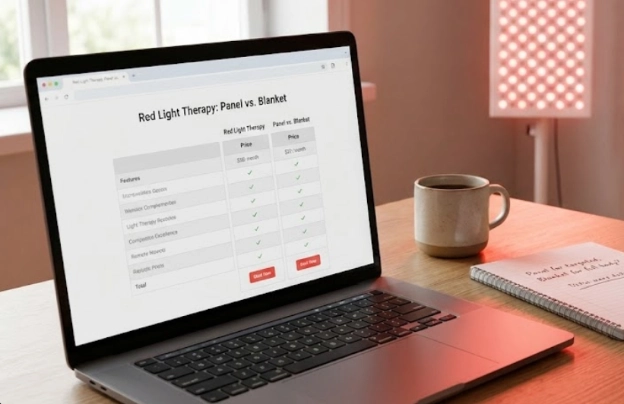
This is the moment it gets real: power on one tab, convenience on the other.
If you are deciding between a blanket or mat and a panel, stop asking which one is better and start asking which one you will actually use when you are tired, busy, and not in the mood.
Panels usually win on intensity and speed. Blankets and mats usually win on comfort and consistency. And consistency is not a soft metric. It is the multiplier that makes all the science relevant to your body’s recovery.
Pick the device that feels like it belongs in your life. Then commit. Start with 30 days. Not perfect. Just consistent. That is when the results start to show up.
Frequently Asked Questions
How long does it take to see results from red light therapy?
Many people notice small shifts within two to four weeks, like easier recovery or calmer skin. Bigger changes tend to show up after a month or two of consistent use.
Do I need eye protection with a red light panel?
Most people do. The brightness is the issue more than danger in normal use. If your eyes feel strained, treat it like a warning light and protect them.
Can I use a red light blanket or mat every day?
Often yes, especially if sessions are comfortable and not too long. Start with shorter sessions for the first week or two and build up based on how you feel.
Is higher irradiance always better?
No. Higher irradiance can reduce session time, but it can also increase the odds you overdo it early. The best dose is the dose you can repeat without feeling worse.
What wavelengths should I look for in a panel or blanket?
Most devices aim for red around 660 nm and near infrared around 850 nm. Red tends to be more surface focused, near infrared goes deeper. A mix is common.
What is better for sleep, a panel or a mat?
A mat or blanket often fits sleep routines better because it is passive and calming. Panels can work, but the bright, upright vibe is not always the easiest path to winding down.
What is the biggest mistake people make with red light therapy?
Buying for specs instead of behavior. A perfect device that you use twice is worse than a decent device you use four times per week.
Keep exploring
Are compression boots worth it
If the reason you even looked up red light therapy blanket vs panel is “my legs feel cooked,” this helps you decide whether compression is a real upgrade or just expensive air.
Do massage guns help with soreness
When you want fast relief without setting up another ritual, this breaks down whether a massage gun actually moves the needle or just feels good for five minutes.
Does Pemf therapy really work
If you are building a small recovery stack at home and trying to avoid buying gadgets that collect dust, this is a grounded look at whether PEMF has real signal or just marketing hype.
This article is for informational purposes only and is not intended to provide medical advice. Always consult your qualified healthcare professional before beginning any new health, wellness or recovery regimen.