
Red Light Therapy for Knee Pain: Placebo or Proof ?
-
The Science: How Red Light Therapy Actually Targets Knee Pain
-
Why don't some doctors recommend red light therapy?
-
Osteoarthritis vs. Acute Injury: Realistic Expectations for Recovery
-
How to use red light for knee pain?
-
Panels vs. Wearable Wraps: Which Device is Right for Your Knee?
-
What is the number one mistake that makes knees worse?
-
Conclusion: Is Red Light Therapy Worth It for knee pain?
- Frequently Asked Questions
You sometimes realize something is wrong when you catch yourself stopping in front of a flight of stairs to rethink if it's worth the effort. Yes, “taking the stairs”. Its usually not a conscious decision at first. However, after a while subconscious avoidance sets in because you knew that deep, grinding knee pain is something you’ll have to deal with later.
For a lot of us who thrive on pushing our limits, knee pain feels like a betrayal. You spend years fine tuning your diet, tracking your sleep, and optimizing your workouts… only to have a single joint dictate what you can and cannot do. It is incredibly frustrating to feel like your engine is ready to go… but the wheels are falling off.
EndureWell was started because I was tired of that kind of frustration. I wanted to know which recovery tools were legitimate science and which were just expensive psychological crutches. I am not a doctor and I don't pretend to be one. I am just someone who is obsessed with performance and refuses to accept "slowing down" as the only option.
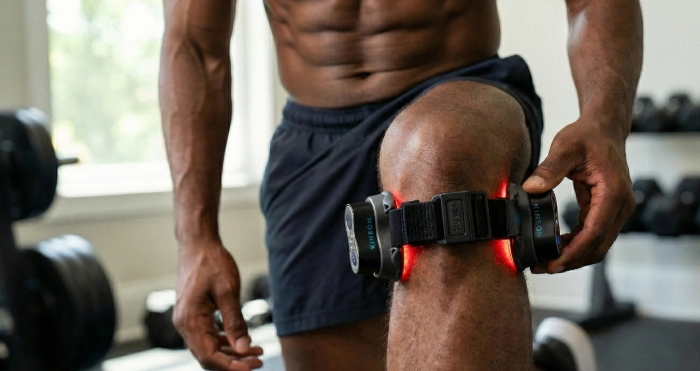
That is what led me down the rabbit hole of red light therapy for knee pain. You have probably seen a few ads for glowing red wraps and futuristic panels claiming to fix everything from wrinkles to full blown arthritis. But does it actually work for the knees? Is there real biology happening under that red glow, or is it just the placebo effect keeping us warm?
We dug into the research, analyzed the mechanism, tested specific devices..and looked at what actually happens when you shine specific wavelengths of light on a damaged joint. Here is the unfiltered truth.
The Science: How Red Light Therapy Actually Targets Knee Pain
Let’s strip away the marketing jargon for a few minutes and look at the biology. Red light therapy isn't magic. It is a biological mechanism called Photobiomodulation (PBM).
When you expose your knee to specific wavelengths of light, specifically Red (630 to 680 nm) and Near Infrared (810 to 850 nm), you are not just ‘warming up the skin’. You are sending energy deep into the tissue. These wavelengths penetrate past the dermis and reach the joint capsule, cartilage, and bone where they interact with your mitochondria.
Think of your mitochondria as the engines inside your cells. When you are injured or dealing with chronic inflammation, those engines are sputtering. The light activates an enzyme called cytochrome c oxidase,... which kicks off a chain reaction that dramatically increases the production of Adenosine Triphosphate (ATP!).
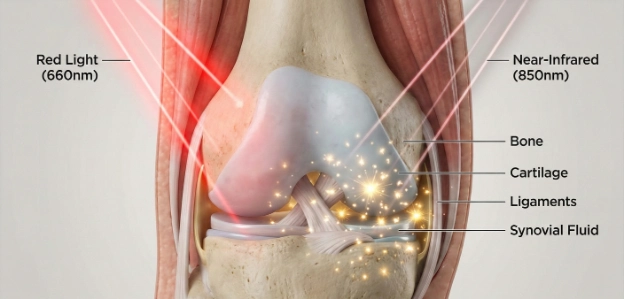
Visualizing the difference: Red light treats surface skin, while Near-Infrared (NIR) penetrates deep into the joint capsule to stimulate ATP production.
ATP is cellular currency. When your joint cells have more cash on hand, they can afford to do the expensive work of repairing tissue and making more collagen… rather than just trying to survive the day. This is critical because research shows that peak ATP synthesis actually occurs three to six hours after a treatment session.
But it goes well beyond just energy. Chronic knee issues are usually fueled by inflammation. The light helps calm this wild storm by reducing pro inflammatory cytokines. It has been shown to lower the presence of COX 2,...( which inhibits the production of the molecules responsible for that throbbing pain you feel after a long walk).
Perhaps most surprisingly, there is real evidence for cartilage health. We often hear that “your cartilage can't heal”.. because it lacks blood flow. But studies have demonstrated that redlight therapy can stimulate fibroblasts to create collagen. If you want to understand how this same mechanism applies to other areas of your body (beyond just the knee)... looking into the broader science of Red Light Therapy for Joint Pain. We go over cellular principles that are universal across your skeletal system.
Why don't some doctors recommend red light therapy?
So If the science is so solid, why didn’t some orthopedic surgeons hand you a red light device instead of a prescription for anti-inflammatories?
Fair question right?!.., and the answer isn't a weird conspiracy. It is usually just caution. Doctors operate on standardized protocols, and for a long time, red light therapy was the Wild West.
There is a fundamental difference in how surgeons and biohackers approach the body. Many experts often point out, if you have a “mechanical” problem, light will not reverse it. If your meniscus is torn in half … or your ACL is ruptured, no amount of red light will physically stitch it back together. Surgeons fix structure. Light fixes cellular function.That's the difference!
The data has also been historically messy. Some older studies used tiny energy doses that did nothing, while others used massive doses that worked. Because there wasn't a standard prescription, medical professionals hesitated to endorse it.
There is also the scam factor. The market is flooded with cheap, rebranded LED strips… sold as “medical devices”. When doctors see companies making wild claims, they naturally become skeptical of the entire industry. They are honestly just protecting you from snake oil,... even if the underlying technology is sound (or sounds good).
Osteoarthritis vs. Acute Injury: Realistic Expectations for Recovery
One of the biggest lessons I have learned is that managing your expectations is the key to success. Your timeline for real relief depends entirely on why your knee hurts in the first place.What caused it?
If you are dealing with osteoarthritis, that means you are fighting a slow, chronic war against inflammation and degradation. You cannot expect a miracle in week one. The first couple of weeks will feel like nothing is happening. The turning point usually arrives around weeks three or four. That’s when morning stiffness starts to fade and you realize you walked down those same stairs without wincing.
The science supports this slow burn approach. A very recent double blind study on High-Energy Photobiomodulation Combined with Rehabilitation Exercise for Mild-to-Moderate Knee Osteoarthritis (2025) is currently changing how we view this. Unlike older research that just asked patients if they felt better (“what’s your pain level on a scale of one to ten”)..., this trial uses radiographic imaging to look for actual structural changes in the knee joint over three months. This is huge because it suggests we might be moving from simply masking symptoms to actually modifying the recovery process. .
On another hand, if you are an athlete dealing with an acute sprain or a tweaked knee from running, jumps, rapid change of direction drills etc,...your goal is accelerated recovery. Meaning, you are trying to boost blood flow to that surrounding soft tissue. This then supports the joint while it heals. But you have to be careful. You should never use excessive heat on a fresh injury during the first 48 hours… so you must ensure your device does not emit thermal heat.
How to use red light for knee pain?
I know.. you don't have time to waste on treatments that take hours. You want the minimum effective dose. Here is the protocol that balances efficiency with biology.
You need to focus on the wavelength. Red light is great for skin, but for a deep joint like the knee, you absolutely need Near Infrared light in the 810 to 850 nm range. This penetrates the capsule.
Distance is the next critical variable. Light dissipates quickly. If you hold a panel more than six inches away, you start to lose a massive amount of energy. For your knees, you want the device as close as possible.

Efficiency in action: Using a wearable wrap allows you to treat knee pain while working, ensuring you actually hit the daily frequency required for results.
Frequency matters more than intensity. Sorry, you cannot cram a week's worth of recovery into one hour. For acute issues, daily sessions are ideal. For chronic maintenance, three to five times a week is the sweet spot. A massive Network Meta-Analysis Comparing 12 Physical Therapy Options for Knee Osteoarthritis (2025) analyzed nearly ten thousand patients and found that High Intensity Laser Therapy ranked second for pain relief, (outperforming many standard physical therapy interventions). This proves that getting the dosage right is non-negotiable.
Just be careful not to fall into the "more is better" trap. You might be thinking can you do red light therapy twice a day, and the answer is usually no. Just like your muscles need rest after a workout to grow, your cells need time to process the light signals. Overloading them can actually stall your progress.
Panels vs. Wearable Wraps: Which Device is Right for Your Knee?
This is the most common dilemma. Should you buy a large panel to treat your whole body, or a specific wrap for your knee?
There is a strong case for wearable wraps when it comes to joint pain. Knees are bony and round. This makes it a bit more difficult to treat with a flat panel. A panel sitting six inches away scatters a lot of light. A wrap sits directly on the skin, and maximizes absorption.
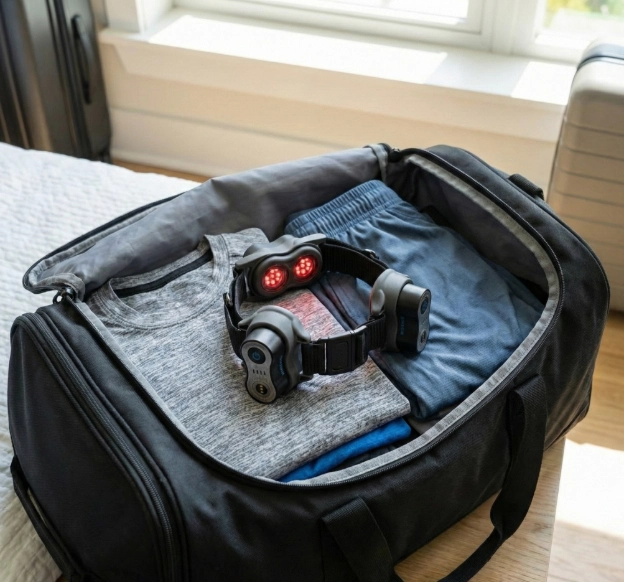
The consistency factor: Large panels are powerful, but you can't fly with them. A compact wearable ensures you don't skip recovery sessions while on the road.
There is also the "habit factor." You are much more likely to stick to a protocol if you can wear a device while you are working at your desk …or watching a movie. Many people report better results with wraps simply because the convenience ensures they actually do the sessions every day. If you want to understand the mechanics of why this form factor works so well, diving into red light therapy belt benefits will explain how direct contact increases effectiveness.
Now, on the flip side. Panels offer raw power. If you want to treat your quad, hamstring, and knee all at once (to fix the entire kinetic chain) a panel is superior. But you have to be disciplined enough to sit in front of it for twenty minutes (without moving!).
For specific knee pain, we generally lean toward dedicated wraps. Devices that use lasers rather than just LEDs, which you can see in our Kineon red light therapy review. Lasers often provide deeper penetration which is exactly what a dense joint requires.
What is the number one mistake that makes knees worse?
We need to have some real talk. You can buy the most expensive device on the planet, but it will not work if you make one specific mistake. That mistake is….. excessive rest!
Let me explain. When your knee hurts, your instinct is to stop moving to protect it. But when you stop moving, the muscles around the knee weaken and stiffen. This leaves the joint less supported, which leads to more pain, which leads to more rest. It is a vicious cycle.
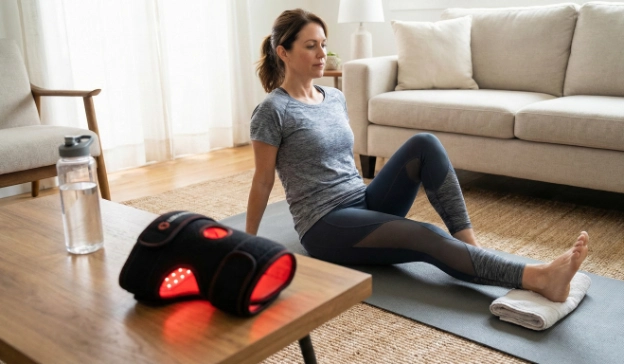
The "Gateway to Movement": Use the light to dampen inflammation, then immediately perform gentle mobility work. Resting too much is often what keeps the knee stiff.
The number one mistake is waiting for the pain to hit zero before you start moving again. Red light therapy is not a replacement for movement. It is a gateway to movement. The goal of using the light is to reduce inflammation just enough so you can tolerate gentle exercise and movement.
The impact of this was proven in a Photobiomodulation for Post-Surgical Knee Recovery (2025) trial. Patients who used light therapy after knee surgery walked 68% further in a walking test just days after their operation… compared to those who didn't. The light reduced the swelling enough to allow for early mobility,... and THAT mobility is what actually healed them.
Use the light to buy yourself a window of relief,... and then use that window to move. That is how you fix the knee.
Conclusion: Is Red Light Therapy Worth It for knee pain?
Red light therapy is not a magic eraser. It won't regrow a vanished meniscus overnight, and it won't fix poor biomechanics (Yes, train those agonist and antagonist muscles..for any athletes reading this). Red light therapy is one of the most powerful tools we currently have for managing the cellular environment of our joints.
If you are dealing with the chronic grind of arthritis or trying to bounce back from a sports injury, it offers a way to reduce inflammation and boost energy production without relying on pills.
The people who see results are the ones who commit to the process. They push through that boring three week plateau. They pair the light with movement. They take control of their recovery rather than waiting for it to happen.
If you are ready to stop avoiding the stairs and get back to the activities that make you feel like yourself,.. this is a tool worth adding to your recovery arsenal.
Frequently Asked Questions
How long should you do red light therapy on your knee? You should aim for ten to twenty minutes per session. Doing less than ten minutes is often insufficient to trigger the cellular response, while doing more than twenty minutes offers diminishing returns and can sometimes negate the benefits.
What vitamin deficiency causes knee pain? Vitamin D deficiency is heavily linked to joint pain and the progression of osteoarthritis because it is crucial for maintaining bone health. A lack of magnesium can also contribute to the problem by causing muscle cramping and tension in the quads and hamstrings that pull on the knee.
Can red light therapy make knee pain worse? It is rare, but some people experience a temporary increase in soreness during the first few sessions. This is often a "detox" style reaction caused by increased blood flow waking up a dormant, stiff area. It usually passes within a few days of consistent use.
Does red light therapy work through clothes? No, it does not. Fabric blocks and reflects the light photons before they can reach your skin. For the therapy to be effective, the light must hit bare skin directly without any barriers.
Can I use red light therapy after knee replacement surgery? Yes, and recent research suggests it can significantly reduce swelling and improve walking distance in the first week after surgery. However, you should always consult your surgeon before applying anything to a surgical site to ensure it does not interfere with your specific recovery plan.
Is heat or red light better for knee pain? Heat is excellent for loosening up chronic stiffness and relaxing muscles, while ice is for acute swelling. Red light is different because it focuses on cellular repair and inflammation reduction. It can often replace heat, but it offers deeper healing benefits that heat pads cannot provide.
Does insurance cover red light therapy for knees? Generally, insurance does not cover at home red light devices. While some chiropractic or physical therapy clinics may bundle it into a visit, purchasing a device for home use is typically an out of pocket expense, though HSA or FSA funds can sometimes be used.
Keep Exploring
If red light is about "feeding" the cell with light, this technology is about "recharging" it with invisible waves. It feels like absolutely nothing is happening..no heat, no vibration..yet NASA studied it to keep astronauts' bones from deteriorating. Is it the ultimate hack for deep joint fatigue?
You have seen them on every NBA sideline. The giant inflatable "space legs." They promise to physically flush out the fluid and metabolic waste that settles in your knees after a long day. But does that rhythmic pneumatic squeeze actually engineer recovery, or does it just feel like a nice massage?
We just discussed how light stimulates collagen and life inside your knee joint. Now, imagine aiming that same biological "fertilizer" at your scalp. If you have noticed the shower drain collecting more strands than usual, you might be surprised to see how this knee-healing mechanism applies to a completely different kind of growth.
This article is for informational purposes only and is not intended to provide medical advice. Always consult your qualified healthcare professional before beginning any new health, wellness or recovery regimen.
-
The Science: How Red Light Therapy Actually Targets Knee Pain
-
Why don't some doctors recommend red light therapy?
-
Osteoarthritis vs. Acute Injury: Realistic Expectations for Recovery
-
How to use red light for knee pain?
-
Panels vs. Wearable Wraps: Which Device is Right for Your Knee?
-
What is the number one mistake that makes knees worse?
-
Conclusion: Is Red Light Therapy Worth It for knee pain?
- Frequently Asked Questions